‘AND’ Power

I was standing in a circle with leaders, designers, and founders – where Steven Colbert, Steve Carell, Mike Myers, Joan Rivers and others had stood before us. In Chicago’s improv comedy theatre, Second City.
It was one day of summer bootcamp at the Institute of Design, our improv host said, “Imagine you are about to go on holiday: someone start, suggest a place and then pass to the next person, who leads with ‘yes, or’”. I can’t recall the exact suggestions, but it went something like:
Person 1: “Let’s go skiing in Aspen.
Person 2: Yes, we could go to Aspen, or we could go diving in the Bahamas.”
Person 3: “Yes, diving in the Bahamas, or imagine a decadent week in New York!”
...and so on.
The energy was flat as options were constantly countered.
“OK, switch – start with the same idea and say “Yes, and”. With that, the energy went up and creativity flowed. The conversation went something like:
Person 1: “Let’s go to Aspen to ski!”
Person 2: “Yes, and let’s make it a food and ski experience”
Person 3: “Yes, and we can fly from the snow to Fiji to thaw out in the sun for the final three days.”
...and so on!
While we did a few other improv activities, this deceptively simple one generated so much energy and connection. I didn’t know then that Second City had pioneered the “Yes, and” technique.
It’s now a standard go-to phrase when opening up the possibility space and generating ideas.
Leveraging tension
"If you see the upsides of stability, you naturally see the downsides of change and vice-versa”, but they are actually interdependent.
Where I first heard this, as someone allergic to either-or thinking, it reinforced the power of “Yes, and.” It spoke to decision-making as not choosing between opposites, but as designing with both.
It's been a go-to for me in the decade since Russ Gaskin CoCreative shared it at an OD conference hosted by Meredith Osmond, Thought Partners.
It’s polarity thinking.
Dr. Barry Johnson pioneered polarity management/thinking as a way of working with dynamic tensions that don’t disappear. Polarities exist when both seemingly opposing points of view are true.
He stated that too often, leaders try to “solve” a polarity. But polarities aren’t problems to be fixed- they are design tensions to be leveraged.
Why Use it?
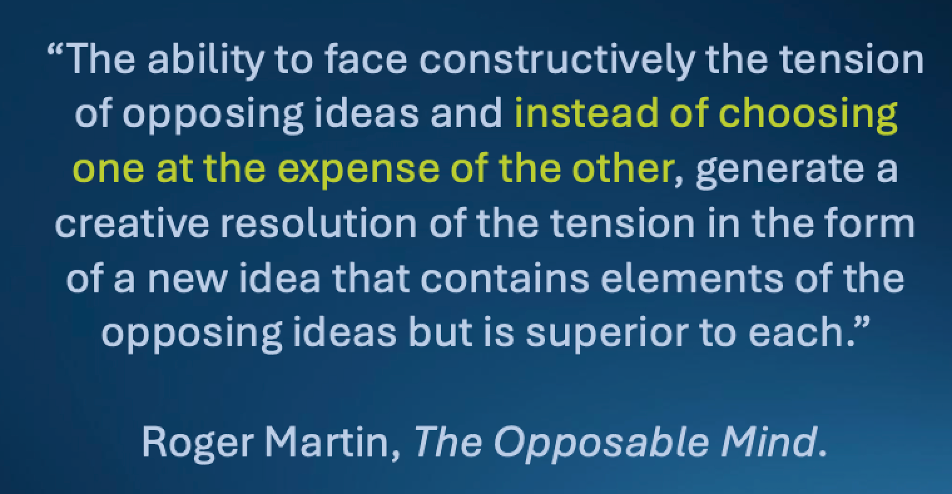
Creative leaders embrace both sides of a polarity to surface superior concepts. They do not pit ideas against each other at the outset, but remain curious and hold the 'AND' space open. They channel the tension of seemingly opposing ideas or points of view into innovative solutions.
Think of the tensions you might be grappling with. What are they?
Freedom and Responsibility?
Honesty and Diplomacy?
Information Transparency and Information Security?
My favourite is Stability and Change.
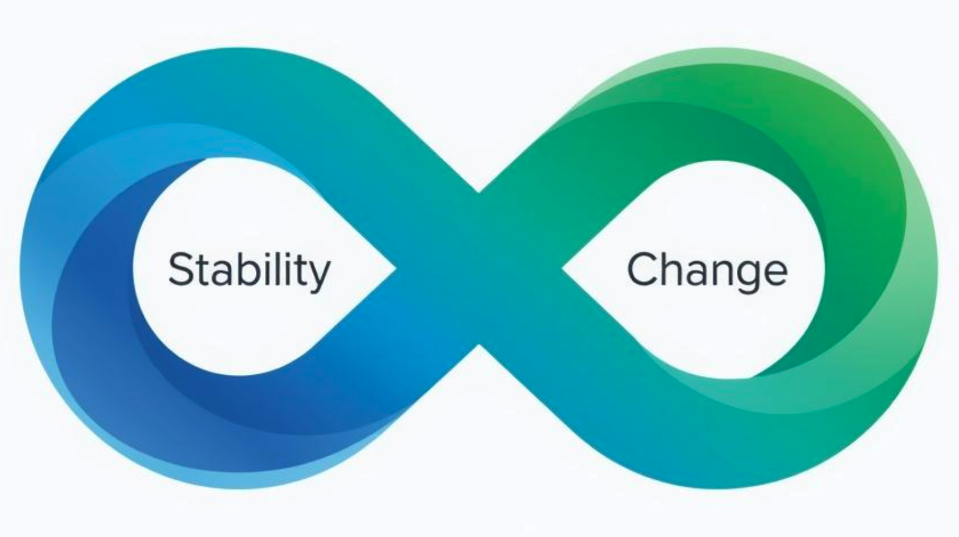
People often think that if they embrace stability, they must reject change (and vice versa). We see it in business and in government. This belief traps too many leaders.
In Government, there is a constant call for more innovation, but the implicit system goal is stability. As Peter Senge said, rather than pushing harder, “artful leaders discern the source of resistance. They focus directly on implicit norms, etc.”
Business has more of an imperative and appetite to embrace both sides of this polarity.
Whether you are in Government or business, understanding this dynamic enables you to break from either/or decision-making to designing for coexistence.
A first step is making the blocking norms, which are implicit, explicit. I’ve seen entire leadership teams break free of gridlock by doing this, simply adding an ‘AND’ lens instead of an ‘OR’ one.
In one workshop, three tiers of leaders worked through the stability/change polarity together, and within 2 hours, alignment and respect had replaced friction. While they still needed to put this into practice and anchor the change, they had made their implicit norms visible to all.
Why This Matters Now
Marty Neumeier made the case when he said, “Competitive advantage is no longer based on efficiency but on differentiation through creativity.”
In this chaotic world, creativity can get squeezed out. As leaders become more hectic, I’m noticing a drift back toward either/or thinking in some quarters, as some of us seek a firmer footing. What might be driving this is:
Do we innovate and risk rocking the boat?
Or be steady and risk irrelevance?
The truth is, you need both. Change without stability is chaos. Stability without change is stagnation. The art of leadership is designing for both. How might you celebrate operational efficiency AND organisational creativity?
If you’re leading today, ask yourself:
Where am I defaulting to “either/or”?
How might I reframe this as “both/and”?
How might I create respect for both across my team and replace the friction?
Leadership isn’t about avoiding the unknown; it’s about designing with it. It isn’t about eliminating tension. It’s about designing with both.
Know someone shaping what’s next? It’s a great but tough gig! Forward this newsletter to them - every future-shaper needs allies!