Shape, Don’t Offload
The Boundary Question
During my last trip to LA, on my way to see a new lawyer of all things, I glimpsed the actors’ strike. One of their placards read: “We are not digital replicas.”
Fast forward to today, and a lot of other professions are asking the same question: Where do we draw the line between partnering with AI and offloading to it?
The Manila Conversation
In my last newsletter, I shared a stimulating dinner conversation at an Innovation Lab in Manila I was helping out. The focusing question was:
“What if AI's highest purpose isn't efficiency, but equity?”
Jessie Hughes, Senior Creative Technologist (Artist-in-Residence + awesome human) at Leonardo.ai / Canva, was one of my conversation partners and my co-facilitator.
As a creative screenwriter, Jessie spoke about the importance of retaining creative control, partnering with AI vs blindly outsourcing your asks and tasks to it.
She said:
“If you cognitively offload to AI, it can make you lazy, and you will experience brain mush or atrophy. We need to partner creatively with it and bring our ideas to life in stunningly new ways!”
Since then, I’ve heard ‘cognitively outsource,’ ‘atrophy,’ and ‘critical thinking’ mentioned a fair bit. It got me thinking about agency.
The Agency Slider
I sketched this simple slider to visualise how we engage with AI:
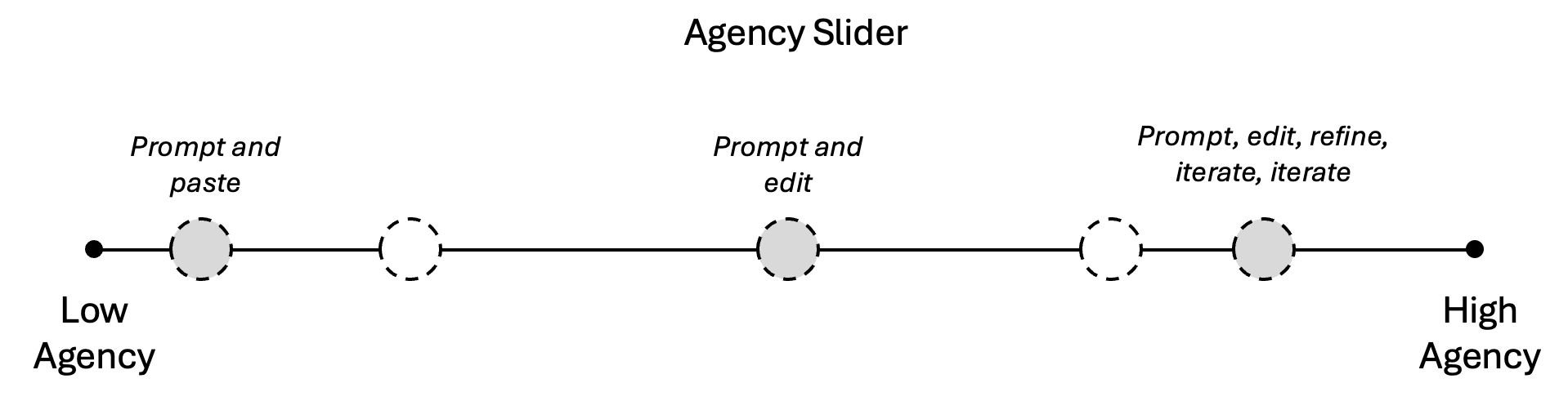
Low Agency: Prompt….. cut and paste | minimal brain engagement.
Medium Agency: Prompt… edit | some creative control, some delegation.
High Agency: Prompt…. refine, iterate | strong creative control, intentional and iterative co-creation.
Every point on the slider has its place, depending on the task, the pace, and your purpose. But the more agency you hold, the more your creativity - not your prompt alone and resulting algorithmic gymnastics - is shaping the output.
Why This Matters
This matters more than we might realise.
While AI once excelled at mining data lakes, swamps, and oceans, generative AI now transforms our intent, insights, and ideas into creation.
But if we simply give away our agency, especially by offloading insight generation, we miss the gold that comes from those very human moments where curiosity, interest, and empathy bring hidden nuggets to the surface.
A Lesson from Urban Design
A while back, I worked with Singapore urban designers who were creating a new suburb - Punggol North, a vibrant new district to be underpinned by cutting-edge technology, as well as urban and social innovation. We sent the urban designers and engineers into the field to interview and observe the people in the community they were designing for.
I still vividly remember the aha moment when they were sifting through their research to make sense of it. One of them said, “Wow, we are in danger of designing out life’s simple joys”, that is, they were unintentionally designing out simple human joys from their community spaces. Spaces where older people could just meet under a shade, talk or watch the life around them, spaces for students to hang out and play an impromptu game, etc. It was something obvious (once seen) and profound at the same time.
No algorithm would have surfaced that insight, but connecting with the community (old and young), including field observations, did. Even if AI could surface an insight like this in the future in the future, the conviction and shared aha moment this team experienced - you could see it in their eyes - translated into a deep commitment to design differently as a result.
If AI were around, though, they could have then made a conscious choice, i.e. medium or high agency, to creatively duo-ed with it. To dive deeper into their “simple joy” insight, designing as range of possibilities and simulations from multiple perspectives at pace.
The Takeaway
Treat AI as your creative amplifier, not your cognitive crutch. The goal isn’t to offload thinking, it’s to elevate it.
Create and value moments where your brain spots an insight like the glimmer of a gold nugget on a riverbed. Leverage AI as your creative duo partner, not your substitute.
Leaders who unconsciously give away their agency and creative control will build fragile organisations. Leaders who intentionally choose what level of agency to retain or outsource will build resilient ones.
Over to You
What level of agency are you operating with today: offloading, editing, or truly co-creating?
If this perspective sparked something of interest, please share it with someone it may be useful to.
Wherever you are in the world, if you need a professional sounding board, I’m here for you.
Subscribe to my newsletter - Leading as Designing - a community for leaders shaping what’s next.